FISEKON GmbH – Fischer Elektrokonstruktion

02 — Industry

Electrical design for machine building and automation

Here it is not one plant being built but a product line. The effort is decided not by the first schematic but by the second variant — and by whether the design was prepared for it.

How projects run in this industry

  • The second machine decides the effort, not the first.
  • Manufacturer standards are more binding than any norm.
  • Repeating plant sections demand rules, not individual drawings.
  • Components from many manufacturers must become one safe whole.
  • CE evidence belongs to delivery, not to the aftermath.
  • Products stay in service for decades and must remain demonstrable.

And that is exactly where we come in

  • Electrical design for new developments and product line extensions
  • Building a machine standard that holds across product lines
  • 3D cabinet layout with manufacturing data instead of 2D drawings
  • Product macros, article master data and generator rules, with checking
  • Wire harnesses and cable routing inside the machine

Adjacent trades

  • Control cabinet building
  • PLC programming
  • Installation
  • Commissioning

We do not carry out these trades ourselves. On request we bring in specialised partners and coordinate the interfaces – you keep a single technical point of contact.

Series production means every design decision multiplies. That is why we plan manufacturability, not only function.

In machine building every design decision multiplies. A wire set that is awkward to assemble does not cost time once but in every unit built. Anyone who sets up device tagging, macros and article master data cleanly from the start builds each further machine faster and does not have to reinvent the documentation every time.

Where parts repeat — the same roller conveyor, the same drive, a hundred times over — the work shifts from the drawing to the rule. Product macros and schematic generation are what make plants of this size plannable in reasonable time at all. A generator without checking distributes errors just as reliably, which is why checking is part of the service.

The third characteristic is the interfaces. Automated cells consist of components from many manufacturers that have to become one whole, electrically and in safety terms. That is where the real design work sits: in signal routing, in safety circuits, in whether somebody finds the right signal during a breakdown.

In detail

Which industries this covers

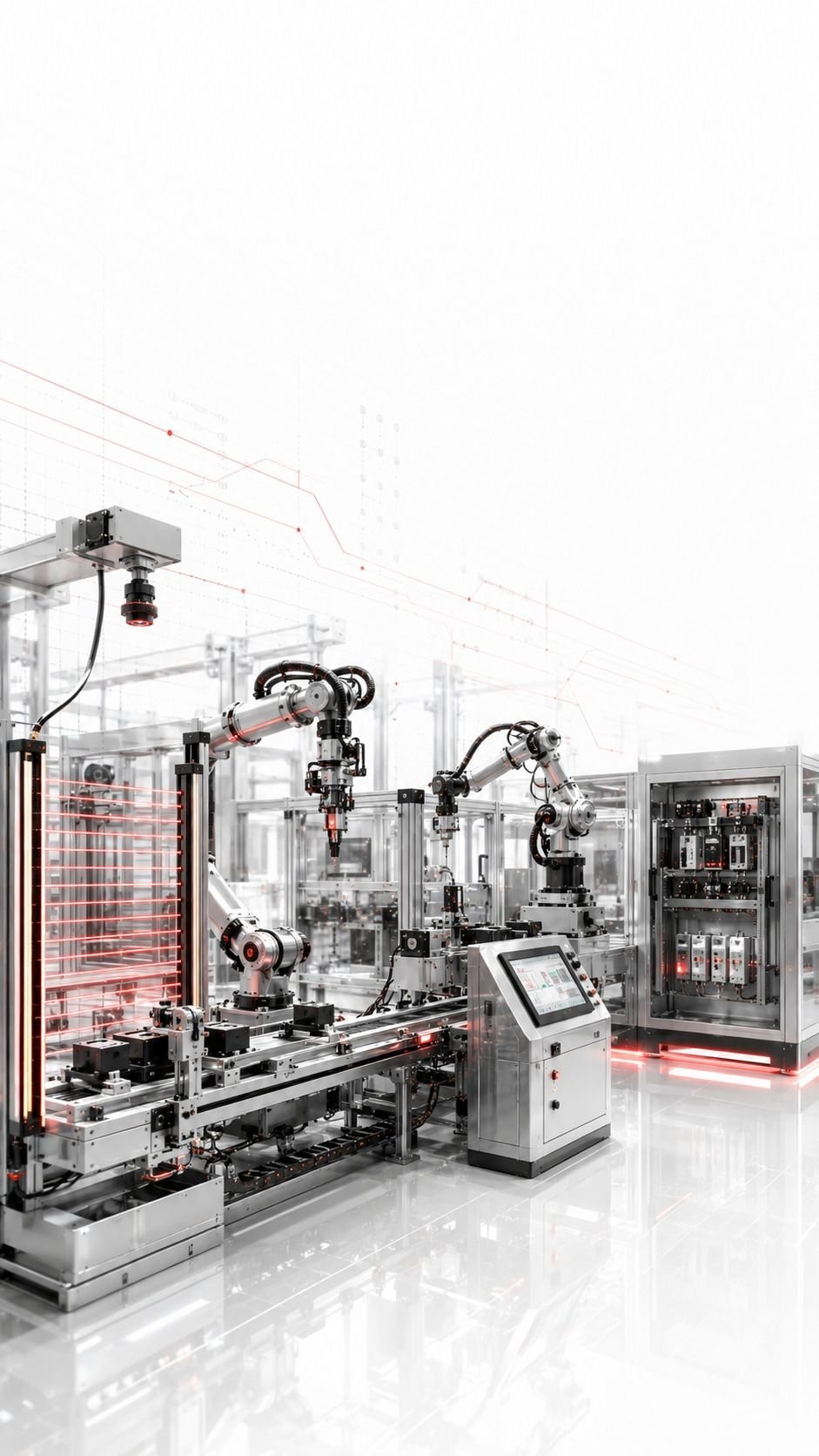
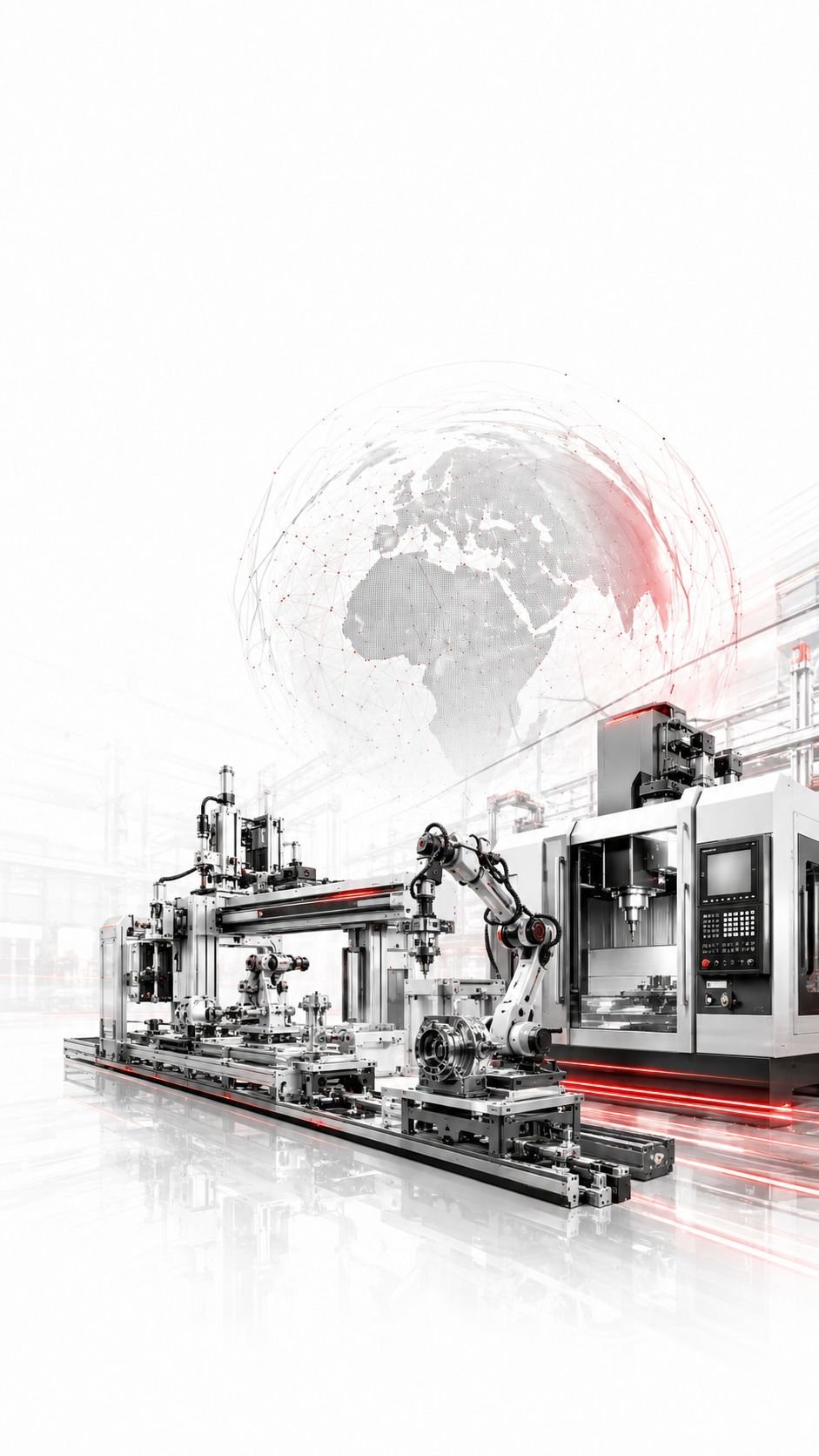
An assembly line with a gantry axis, articulated robots and a machining centre, a plant hall behind.

01Machinery & special-purpose machinery

From a single machine to a series: design that can actually be manufactured.

We design new developments and variants, build the machine standard behind them and deliver manufacturing data instead of room for interpretation.

  • General machine building
  • Special-purpose machinery
  • Machine tools
  • Production and manufacturing machinery
  • Assembly systems
  • Testing machines and test benches
  • Plastics and woodworking machinery
  • Textile, printing and paper machinery
  • Agricultural and construction machinery
  • Tooling, jigs and fixtures
A robot cell with several articulated robots along a conveyor.

03Automation & robotics

Cells, lines and handling systems. Drawn through cleanly, electrically.

We design the interfaces – signal routing, safety circuits – and documentation that is a tool in a breakdown, not just a record.

  • Factory and industrial automation
  • Process automation
  • Robotics and robot systems
  • Assembly and handling automation
  • Test automation
  • Production lines
  • Material flow systems
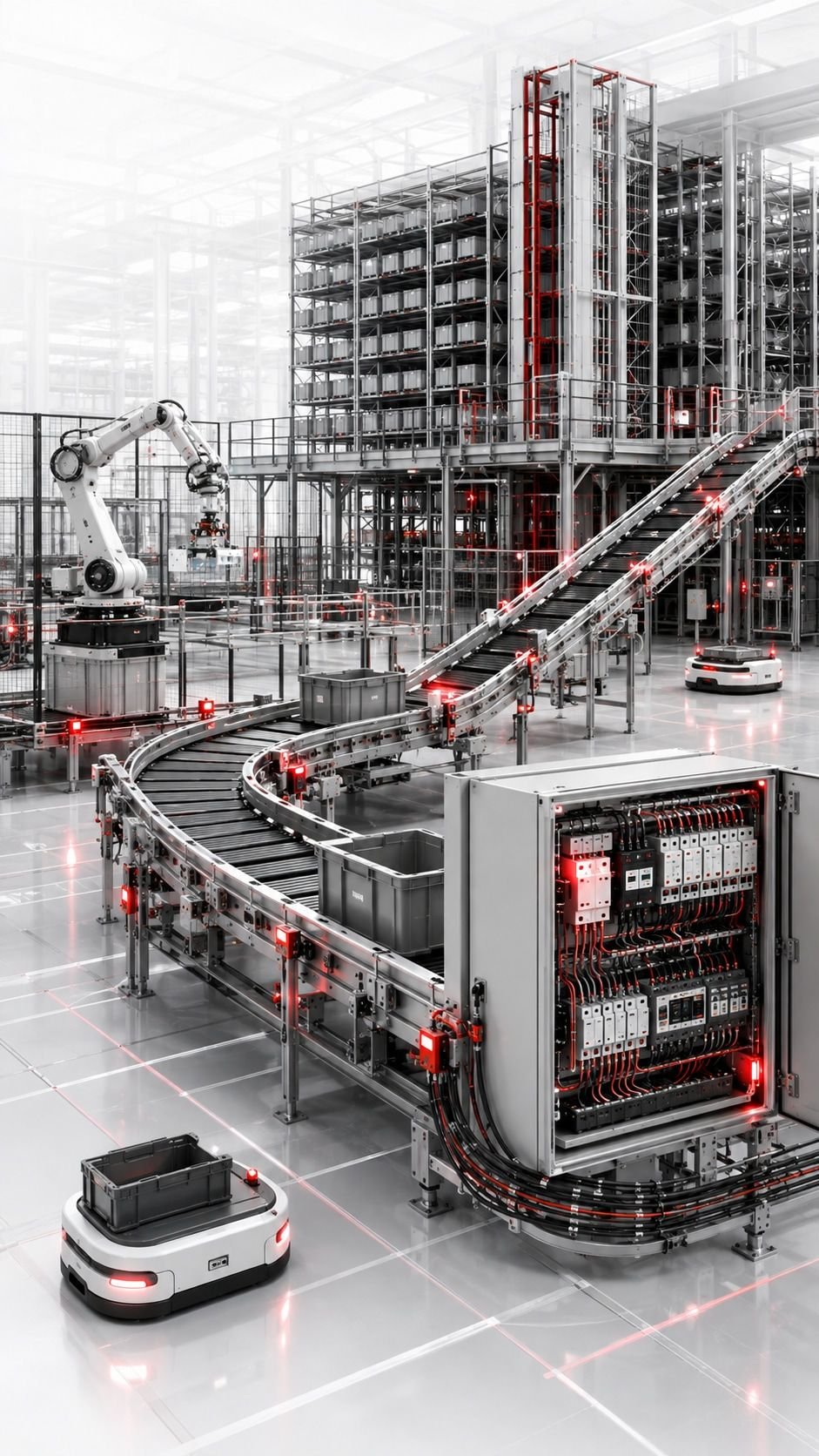
Stacker cranes and conveyors in an automated warehouse.

04Intralogistics & conveyor systems

Hundreds of identical drives, plannable only through standardisation.

We build product macros and generator rules and plan conveyor systems as a system, not as a collection of individual drawings.

  • Conveyor technology and material flow systems
  • Intralogistics and storage technology
  • High-bay warehouses
  • Sorting and picking systems
  • Palletising and packaging lines
  • Baggage and parcel conveyor systems
  • Distribution and logistics centres
  • Automated guided vehicles and AMR
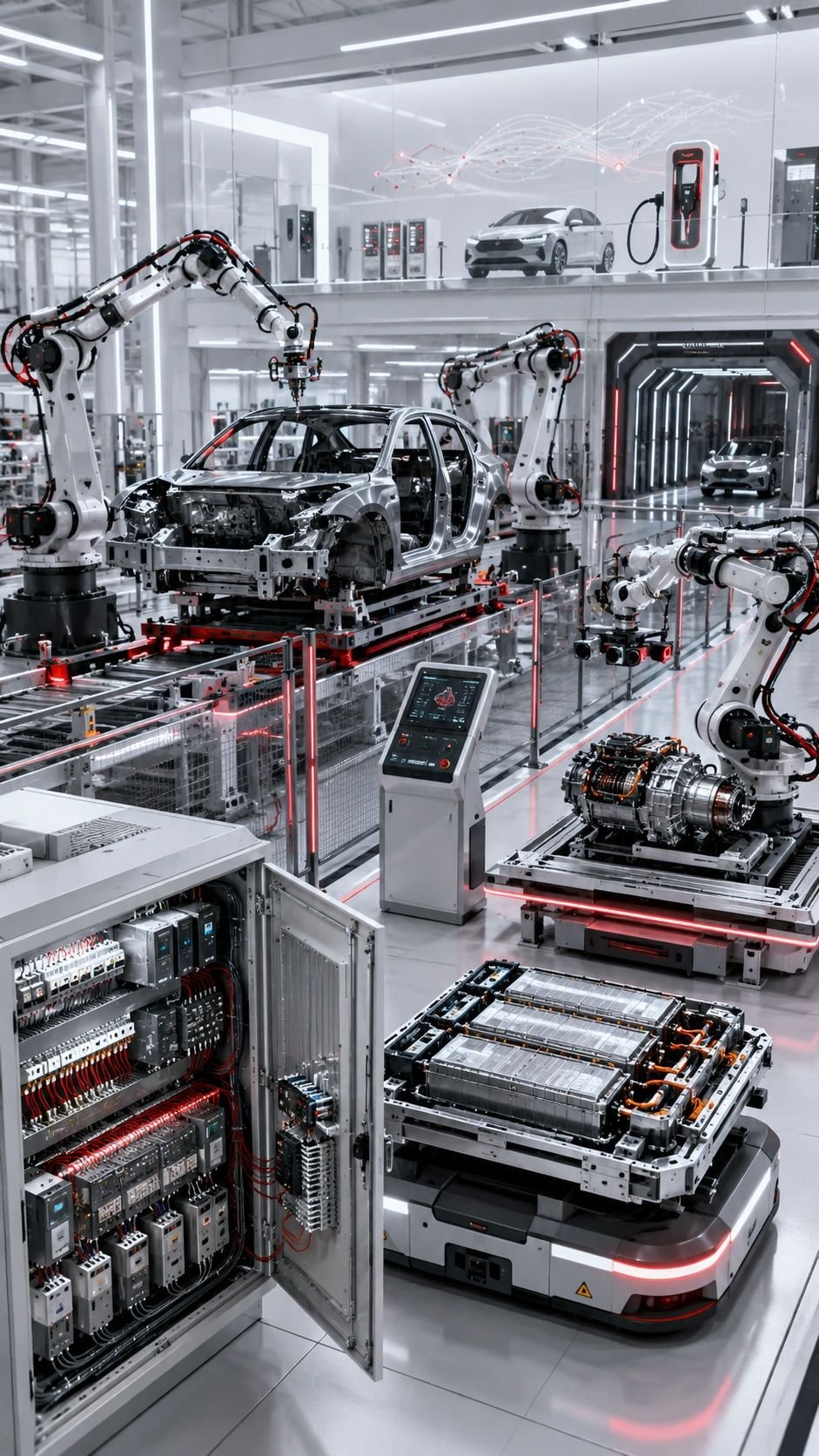
Vehicle production with a body on the line, robots, battery modules and an open control cabinet.

05Automotive & mobility

Two worlds: electrics inside the vehicle, and the plants that build it.

We work in your template and your tagging system – for vehicle and plant projects alike.

  • Automotive industry and suppliers
  • Commercial vehicles, trucks and buses
  • Special-purpose vehicles
  • Body shop systems
  • Paint shops
  • Assembly lines
  • Test benches
  • Electric mobility and battery assembly
  • Tyre industry

13Aerospace, rail & maritime

Their own standards worlds, long life cycles, high evidence requirements.

We establish the applicable framework at project start and design towards the evidence required at the end.

  • Rail technology and rolling stock
  • Rail infrastructure and depots
  • Shipbuilding and marine engineering
  • Shipyards and port facilities
  • Offshore installations
  • Aerospace
  • Ground support equipment and test benches

14Electronics & battery manufacturing

Near-cleanroom production, high cycle rates, young plant generations.

We plan the documentation from the outset as something that changes – with clean versioning instead of correction loops.

  • Semiconductor industry and chip manufacturing
  • Electronics and PCB manufacturing
  • Cleanroom automation
  • Cell manufacturing
  • Battery assembly and battery packs
  • Battery test benches
  • Test and inspection systems

Engineering software & CAE systems

We work inside your system landscape.

  • EPLAN Electric P8

    Electrical design & schematics

  • EPLAN Pro Panel

    3D control cabinet & layout planning

  • EPLAN Harness proD

    Wire harness & cable routing

  • WSCAD

    Electrical design & schematics

  • ELCAD

    Electrical engineering & technical documentation

Frequent questions

Is standardisation worthwhile at low unit numbers?

It pays off as soon as design work repeats — that depends not on unit numbers but on the number of variants. A small programme needs a few solid modules, not a library for every conceivable case. The initial analysis clarifies what makes sense.

Can you design to our standard?

Yes, and that is the normal case. In vehicle technology especially, manufacturer templates are more binding than any norm. We work in your template and with your tagging system, even where it differs from what we would otherwise use.

Do you build the cabinets as well?

No, we plan them — down to the manufacturing data a cabinet builder can work from directly. On request we bring in specialised partners for the build and coordinate the interface.

Contact

Tell us what it is about.

A phone call or three lines is enough. From the very start you talk to the people who will later work on your project, not to a distribution list.

Your contact

Portrait of Olaf KreithOlaf KreithHead of Sales · Braunschweig

Switchboard

Locations

Registered office and postal addressStellmacherstr. 7
33428 Marienfeld (Harsewinkel)
Gütersloh officeWagenfeldstr. 2
33332 Gütersloh

Or write to us

We usually reply within one working day.

Write email

Opens your email program with the message already written. Read it, change whatever you like, and send it yourself — from your mailbox to ours.

Go to the contact form