


Services
Plant electrical design and schematics
Plant electrical design is rarely work on a blank sheet. Usually there is already a plant, a grown structure and a clear idea of how drawings have to look in your house. Our job is to find our way into that and to continue the design so that nobody later notices where your work stopped and ours began.
When outsourcing electrical design pays off
- A project is due and electrical design cannot be staffed internally.
- An existing plant is being extended and the documents have to grow with it.
- A customer standard has to be met for which in-house routine is missing.
- A peak has to be absorbed without building permanent headcount.
Result
- Complete CAE project in your system environment
- Circuit, terminal, cable and assembly drawings
- Parts lists and reports
- Documented labelling systematics
We take on the electrical design there is no time for in house.
- Electrical design
- Since 1998
- Employees
- 15
- CAE systems (EPLAN, WSCAD, ELCAD)
- 3
- Projects since 1998
- 2,300+
Why FISEKON
One contact, not a distribution list
Whoever takes your project also works on it.
Your CAE system, not ours
EPLAN, WSCAD or ELCAD, using your part master.
Existing plants are our everyday work
Plant runs, documents do not match. That is where we start.
Capacity without a permanent post
Design capacity when you need it.
Process
How electrical design with FISEKON works
Recording
We review the existing documents and clarify which standard applies, which template is used and where the installed base differs from the documentation. For existing plants that includes a site visit.
Agreement
Labelling systematics, page structure, article master data and file structure are agreed and written down before the first page is drawn.
Design
Work runs in review cycles. Interim states go to you before an error propagates across a hundred pages.
Handover
You receive the project in your system environment, with reports and in the agreed structure. On request we take over maintenance afterwards.
We design electrical plants and systems for industrial use and deliver circuit and wiring diagrams, terminal and cable plans, assembly and connection drawings. For new projects we plan from the ground up. For existing plants we work into the structure already in place and continue it consistently rather than replacing it.
Creating schematics with us produces circuit diagrams, overview diagrams and terminal and cable plans that can be evaluated rather than merely drawn. Every device carries its designation to IEC 81346 or to your standard, cross-references and article data are correct, and cable lists and parts lists come out of the project without rework. These are schematics that assembly, commissioning and service can work with.
The difference between usable and unusable design rarely shows on handover day. It shows three years later, when a rebuild is due and someone has to work out why a device is named the way it is. So we set up labelling, page structure and cross-references to stay readable without asking anyone.
We work in the system environment you use. Where a customer standard exists it is applied, even where it differs from what we would otherwise use. Where none exists, we propose one and write it down so that it survives the next order.
Scope and depth follow what you need, from individual schematics through complete plant sections to the full electrical design of a new build.
Basics
What is electrical design?
Electrical design, in German Elektrokonstruktion, is the planning of the electrical equipment of a machine or plant and the preparation of all documents needed to build, commission, operate and maintain it. These include circuit diagrams, terminal and cable diagrams, the control cabinet layout and the bills of materials. In machine and plant building it is also called electrical engineering design or hardware design.
Electrical designers decide which devices are used, how they are wired and protected and what they are called. They size cables and protective devices, select contactors, drives and control hardware, plan the PLC inputs and outputs and coordinate with mechanical design, software development and panel building. Individual values can be estimated with our calculators for electrical design.
The work usually runs in two stages. Basic engineering produces the quantity structure, the supply concept and the designation system. The decisions made there are described in the article basic engineering before the circuit diagram. Detail engineering then delivers the circuit diagrams page by page, the cabinet layout and the reports for manufacturing and assembly.
The work is done in CAE systems such as EPLAN Electric P8, ELCAD or WSCAD. There the schematic is a database from which terminal diagrams, cable lists and bills of materials are generated automatically. The framework is set by standards such as IEC 61082 for the documents, IEC 81346 for the reference designation of devices and IEC 60204-1 for the electrical equipment of machines.
Many companies have their own electrical design department and hand peaks, existing plants or whole projects to a design office. How to recognise a suitable service provider is covered in the article outsourcing electrical design. What to prepare for a request is shown in the article outsourcing electrical schematics.
From a project
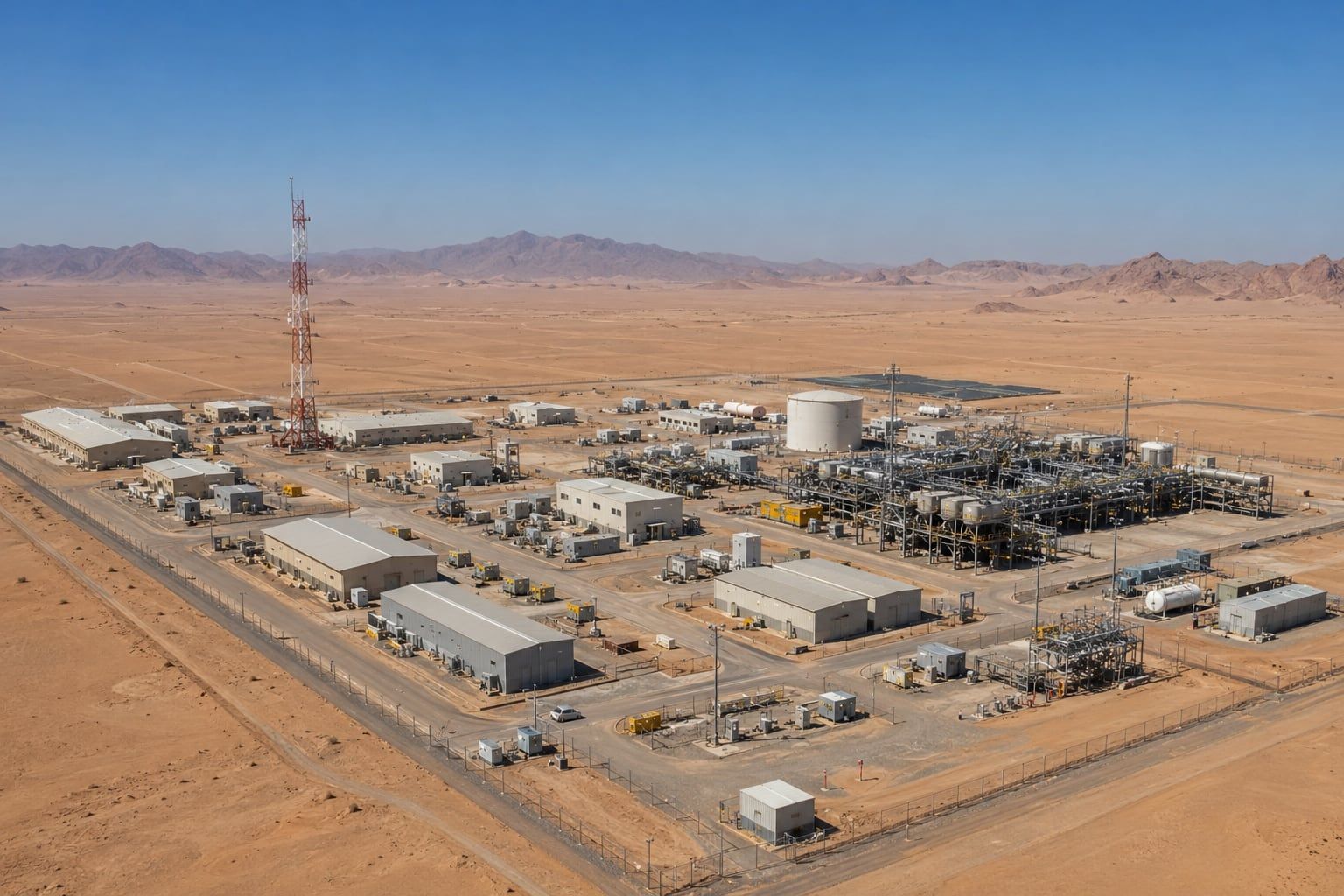
Raw materials
Self-sufficient infrastructure in an extreme location
Electrical planning of a self-sufficient base in the Algerian desert, with reference designations that locate every component to the metre.
Industries where we take this on
- Machinery & special-purpose machineryFrom a single machine to series production. Electrical design that can actually be built.
- Plant engineering & process industryLarge plants, documentation grown over decades, tight shutdown windows.
- Automation & roboticsCells, lines and handling systems. Electrical design that is clean throughout.
- Intralogistics & conveyor systemsHundreds of identical drives, plannable only through standardisation.
- Automotive & mobilityTwo worlds. The electrics inside the vehicle and the plants that build it.
- Energy & renewablesGeneration, storage, distribution and modernising the installed base.
- Chemicals & petrochemicalsInstrumentation, hazardous areas and documentation that withstands an audit.
- Food & beverageHygienic design, wash-down resistance and lines that must not stand still.
- Pharma & life scienceCleanrooms, qualification and documentation that gets audited.
- Water & environmental technologyLong-lived plants, small teams, high availability requirements.
- Metals & heavy industryThousands of measuring points, revised within a non-negotiable shutdown window.
- Buildings & infrastructureWhen safety technology, building management and IT have to be planned together.
- Aerospace, rail & maritimeSeparate worlds of standards, long life cycles, high evidence requirements.
- Electronics & battery manufacturingNear-cleanroom production, high cycle rates, young plant generations.
- Packaging & consumer goodsProduction lines whose documentation connects layout plan to fluid diagram.
- Textile industryMany identical machines, grown halls, old drawings.
- Cranes & hoistsHeavy loads, long cable runs, recurring inspections.
- Amusement rides & leisure facilitiesNew rides from prototype to series production, for markets worldwide.
Calculators for this service
- Cable cross-sectionRequired cross-section from voltage drop and current-carrying capacity.
- Voltage dropVoltage drop across a cable of known cross-section.
- Cable resistanceResistance of a cable from length, cross-section and conductor temperature.
- Cable lossesThe heat and the running cost that stay in the cable itself.
- Maximum cable lengthHow far a cross-section reaches before the voltage drop exceeds the limit.
- Current-carrying capacityBase value times correction factors, checked against the protective device.
- Parallel cablesCurrent sharing, total cross-section and the margin on the most loaded cable.
- Conductor temperatureHow warm the conductor actually gets at partial load.
- Cable capacitanceThe charging current and reactive power a long cable draws with no load at all.
- Short-circuit currentApproximate short-circuit current at the low-voltage terminals.
- Cable impedanceResistance and reactance of a cable, plus the loop through the protective conductor.
- Network impedanceUpstream impedance from the network operator figure, in both directions.
- Short-circuit current at the far endFault current at the far end, with a check of the disconnection condition.
- Thermal short-circuit withstandWhether the cross-section survives the short circuit until the device disconnects.
- Length and disconnectionHow long the cable may become for the protective device to still operate.
- Motor currentRated current of a three-phase motor from power, voltage and efficiency.
- TorqueMotor torque from shaft power and speed.
- Starting currentWhat the motor draws when switched on and how far the voltage dips.
- Star-delta startingCurrent and torque in star, and whether the motor will start at all.
- Soft startingCurrent and torque at reduced initial voltage, with the lowest voltage that still carries.
- Motor efficiencyWhat the motor draws, what stays as heat, and what a better one would save.
- Speed control instead of throttlingWhat a variable frequency drive saves on pumps and fans compared with a throttle.
- Speed and slipWhat is on the nameplate, and what follows from it.
- Setting the motor protectionThe correct setting, and the star-delta trap.
- Single-phase motorCurrent drawn on a single-phase supply, with a three-phase comparison.
- Motor feederCurrent and cross-section of the motor cable, including the voltage drop at start.
- Required motor ratingFrom the torque of the driven machine to the standard motor size.
- PFD and SILProbability of failure on demand to EN 61508 and VDI/VDE 2180, across sensor, logic solver and final element.
- PFH and SILDangerous failures per hour to EN 61508, across sensor, logic solver and final element, for high demand and continuous mode.
- Protective conductor sizeTwo routes to the size, via the thermal proof or the simplified allocation.
- Earth rodEarth resistance from soil, length and number of electrodes.
- Touch voltageWhat voltage stands on the accessible part under fault.
- Residual current protectionAdd up the leakage currents before the plant stands still.
- Check discriminationOverload and short-circuit ranges checked separately, because they behave differently.
- Connecting a surge arresterWhy half a metre of wire can defeat the arrester.
- Enclosure coolingSelf-dissipation of the enclosure and required cooling capacity.
- Reference designationAssemble a designation from function, location, component and terminal.
- Reactive power compensationRequired capacitor rating for a target power factor.
Frequently asked
Questions about electrical design
You have a technical task? We will look at how it can be solved.
Discuss a projectWhat does an electrical designer do?
Electrical designers plan the electrical equipment of machines and plants. They select devices, size cables and protective devices, create circuit, terminal and cable diagrams in the CAE system and make sure that bills of materials and documentation match the plant as built.
Do you take on electrical design projects outside Germany?
Yes. Our team is based in Gütersloh and Marienfeld in East Westphalia and works throughout Germany and in European projects, by remote access in your system environment or on site.
Do you work in our EPLAN environment or your own?
In yours. We use your template, your article master data and your labelling systematics. If you have no environment of your own, we provide one and hand it over completely at the end of the project.
Can you take on individual plant sections only?
Yes, that is actually the most common case. Your team covers the core, we take on defined sections or ancillary plant. What matters then is a clear interface in the labelling.
How does coordination work during a running project?
Through dedicated contacts on both sides and interim states at agreed intervals. On larger projects we are regularly on site or build a project team at your premises.
Can I have schematics created without handing over the whole project?
Yes. We create circuit, terminal and cable diagrams for individual extensions and revisions too, to your standard or to IEC 81346. What makes sense in each case we clarify after a look at your documents.
Which programs do you create schematics in?
In EPLAN Electric P8, ELCAD and WSCAD. The system we use follows your environment, so you can keep working on the drawings without conversion.
What does creating schematics cost?
That depends on the scope, meaning the number of pages and devices, the required standard and whether existing drawings are used as a basis. For a reliable quote, a sample drawing and the key data of the plant are usually enough.
Related services
- Technical documentation & revisionsStructured documentation, revisions and upkeep of existing plant documents. So they are still correct in ten years.
- 3D control cabinet designLayout planning in space rather than on a plane, with manufacturing data, wiring lists and planned cable routes.
- Project support & system solutionsSupport on industrial projects, from planning and document review to coordinating complete system solutions.
Contact
Tell us what it is about.
A phone call or three lines is enough. From the very start you talk to the people who will later work on your project, not to a distribution list.
Direct
- Phone+49 (0) 5247 4070-66
- Emailinfo@fisekon.com
- AvailabilityMon to Fri, 8 am to 5 pm CET
Or write to us
We usually reply within one working day.